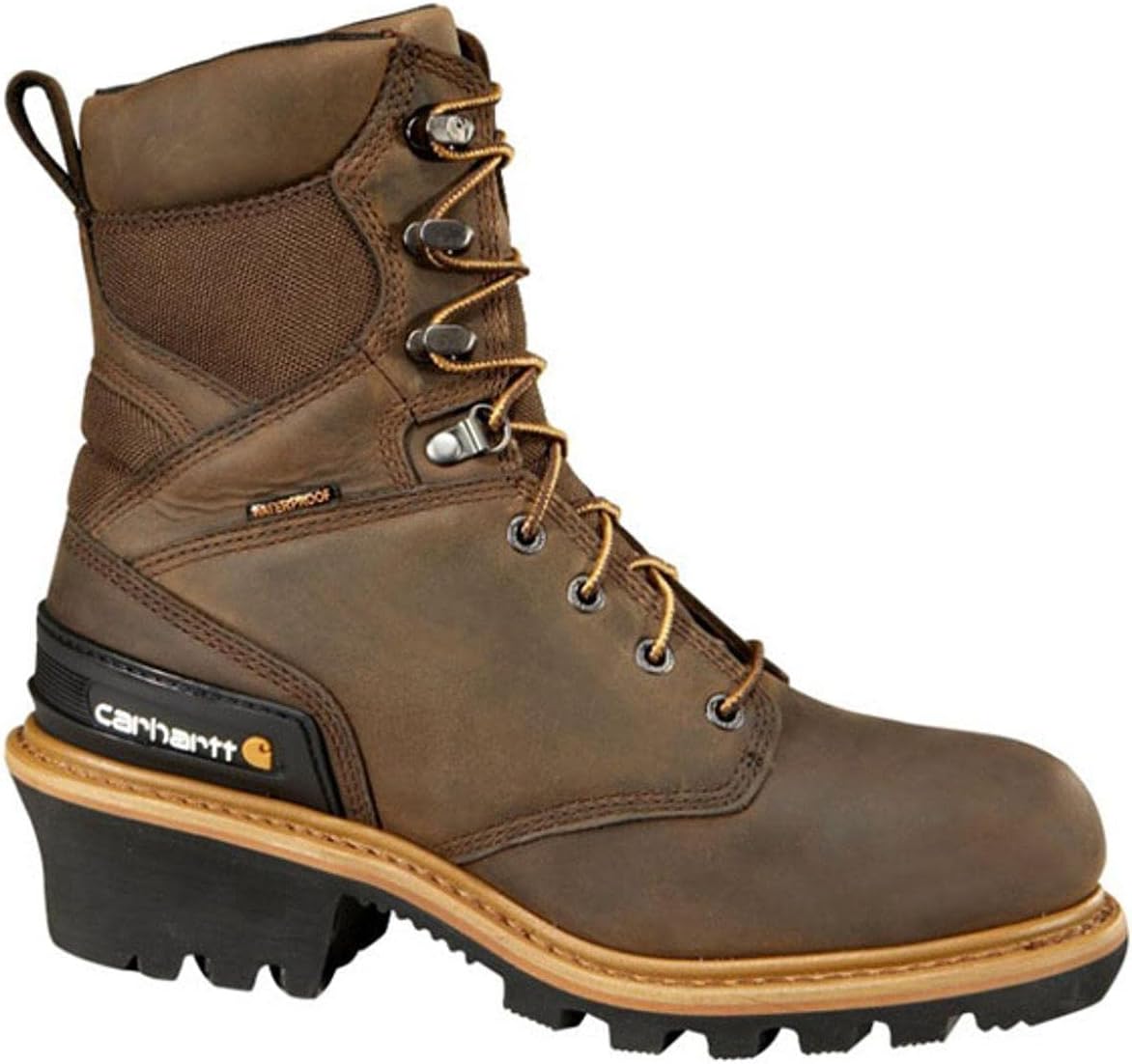
You just dropped $175 on a pair of Carhartt boots, and now your job-site foreman is asking whether they’re EH-rated — meaning safe around live electrical circuits — and your buddy is asking why you didn’t just buy Whites or Thorogoods. Fair questions, both of them. Work boots are more regulated and more construction-specific than most people realize. The safety markings stamped on the inside of a boot’s heel aren’t marketing copy; they’re certifications tied to real ASTM standards (ASTM being the American Society for Testing and Materials, the organization that sets safety benchmarks across industries). This guide breaks down what Carhartt’s logger and composite-toe boot lineup actually delivers — how they’re built, what the EH rating means for electricians and linemen, where the Goodyear welt construction (a specific stitching method that allows resoling and extends boot life) matters, and where Carhartt’s mid-tier positioning makes sense versus where you’d be better served by a longer-horizon investment.
By the end, you’ll have a clear framework: if your job looks like X, buy at this tier. If it looks like Y, spend up.
| EDITOR'S PICKCarhartt 8” Waterproof Leather… | Mid-tierCarhartt 8” Waterproof Leather… | Budget pickCarhartt Men's CMF6366 6 Inch C… | |
|---|---|---|---|
| Type | Logger | Logger | 6" |
| Waterproof | ✓ | ✓ | — |
| Goodyear Welt | ✓ | ✓ | — |
| Slip-Resistant | ✓ | ✓ | — |
| EH Rated | ✓ | ✓ | — |
| Insulated | ✓ | — | — |
| Price | $219.99 | $214.99 | $109.95 |
| See on Amazon → | See on Amazon → | See on Amazon → |
What You’re Actually Buying: Construction Breakdown
Carhartt’s work boot line sits in a crowded middle lane — above fast-fashion safety footwear from big-box retailers, below the fully custom or heritage-cobbled tier occupied by White’s Boots, Nicks Handmade Boots, or Wesco. Understanding the construction tells you whether the price-to-durability ratio works for your use case.
Goodyear Welt Construction
The Goodyear welt is a strip of leather or synthetic material that runs around the perimeter of the boot, stitching the upper (the leather part wrapping your foot) to the insole and then to the outsole. The critical advantage: that outsole can be removed and replaced by a cobbler without destroying the boot. A cemented boot — where the sole is glued directly to the upper — is essentially disposable once the sole wears out. A Goodyear-welted boot can realistically see two or three resoles over its life, which is where the cost-per-wear math changes significantly.
Carhartt offers Goodyear welt construction on several of its logger and work-boot SKUs, though not universally across the line. Heddels’ Boot Construction 101 guide makes the point clearly: welt construction is the clearest single signal of resolability, and resolability is the clearest signal of long-run value. Carhartt’s welted boots carry that resolability — a meaningful step up from cemented competitors at similar price points.
Logger Profile and Heel Height
Logger boots are distinguished by their raised heel — typically 1.75 to 2 inches — and their high-cut shaft (usually 8 to 10 inches). The heel serves two functions: it catches climbing spurs for arborists and utility linemen working wooden poles, and it positions the foot so that a climbing gaff (the spike used to ascend poles) can bite properly. If you’re not climbing poles or working steep terrain, a standard work boot profile is usually more comfortable for all-day flat-surface wear. Logger geometry is purpose-built, not universally superior.
Upper Materials
Carhartt’s logger boots generally use full-grain leather in the upper — the outermost, tightest-grained layer of a hide, which resists moisture and abrasion better than corrected-grain (sanded and buffed) or split-grain alternatives. Owners on the Working Person’s Store review archive consistently note that Carhartt’s upper leather holds up reasonably well through a first resole cycle, though it doesn’t develop the same long-run patina as the thick, oil-tanned leather used by White’s or Nicks. That’s an honest tradeoff at the price point, not a defect.
The EH Rating: What It Means and Why Linemen Care
EH stands for Electrical Hazard. Per ASTM F2413-18 — the governing standard for protective footwear — an EH rating means the boot’s sole and heel have been tested to withstand 18,000 volts at 60 Hz for one minute with no current leakage exceeding 1 milliamp under dry conditions. That’s a meaningful secondary barrier against electrical shock, not a guarantee of full insulation.
The key qualifier is dry conditions. EH-rated boots provide a measurable layer of protection when you’re standing on dry ground and accidentally contact an energized source. Wet conditions, punctured soles, or conductive debris compromising the barrier all reduce that protection. OSHA (the Occupational Safety and Health Administration) requires that electrical workers use appropriate PPE (personal protective equipment) as a system — boots alone don’t satisfy arc flash or high-voltage work requirements.
For linemen working distribution-level infrastructure — utility poles, overhead lines, residential service drops — an EH rating is a baseline requirement, not a premium feature. Carhartt’s EH-rated logger boots carry this certification on eligible SKUs. Gear Junkie’s composite-toe versus steel-toe breakdown notes an important secondary consideration: composite toe caps (made from materials like Kevlar, carbon fiber, or fiberglass) are electrically non-conductive, while steel toes conduct electricity. For linemen and electricians, composite toe is not a cost-cutting compromise — it’s the correct technical specification.
By the Numbers
| Spec | Carhartt Logger (EH/CT) | Thorogood Moc-Toe Logger | White’s 350 Logger |
|---|---|---|---|
| Approximate price (2026) | $155–$200 | $210–$240 | $650–$750 |
| Welt construction | Goodyear welt | Goodyear welt | Goodyear welt |
| Toe material | Composite | Steel or composite | Steel |
| EH rated | Yes (select SKUs) | Yes | Yes |
| Made in USA | No | Yes (Union-made) | Yes |
Tradeoffs Worth Naming Explicitly
Where Carhartt Earns Its Price
At $155–$200, Carhartt’s EH-rated, Goodyear-welted, composite-toe logger boots represent genuine value for mid-frequency professional use. If you’re outfitting a crew of four linemen apprentices who rotate through gear quickly, or if you’re a working tradesperson who needs a resolable, code-compliant boot without a six-month savings horizon, Carhartt makes a defensible case. Owners on Working Person’s Store consistently report 18 to 24 months of working life before the first resole, which at $155 entry and a $60–$80 resole cost puts total three-year cost somewhere in the $215–$280 range — a reasonable cost-per-wear number for non-daily-wear rotation.
Popular Mechanics’ 2025 work boot roundup placed Carhartt among solid mid-tier performers for general tradespeople, noting fit and initial break-in as more forgiving than stiffer premium logger boots, which matters if you’re on a six-month job site and can’t afford two weeks of blistered heels.
Where the Tradeoffs Show
The area where Carhartt loses ground to heritage-tier alternatives is long-run material quality and country-of-origin accountability. Carhartt boots are manufactured overseas (primarily in Asia as of 2026), which affects two things: the consistency of stitching and lasting quality across production batches, and the ability to access the manufacturer for warranty or construction disputes. Thorogood, by contrast, is Union-made in Merrill, Wisconsin — a fact that comes with a documented quality-control structure and a repair infrastructure that aging boots can access domestically. White’s Boots, made in Spokane, Washington, maintains full in-house repair and resole capability, which is why a $700 White’s boot represents a 15-to-20-year investment for serious climbers and linemen, not simply a higher price point.
The other practical gap is outsole compound selection. Premium logger boots allow buyers to specify outsole material — Vibram 430 (a compound known for superior grip and durability), cork midsole, oil-resistant compounds for refinery work — matched to the job environment. Carhartt’s outsole is standardized. For most tradespeople, that’s fine. For a lineman climbing 60 poles a day in the Pacific Northwest, it’s a meaningful limitation.
Break-In Reality
Across aggregated reviews, Carhartt’s logger boots are consistently reported as more forgiving on initial break-in than equivalent heritage-tier options. This matters for tradespeople who can’t take two weeks off to soften leather before a job starts. The tradeoff is that the leather is lighter and less dense than what White’s or Wesco uses, which means break-in is easier because there’s less material — and that lighter material eventually shows wear faster. It’s not a defect. It’s a design choice appropriate to a $175 boot.
The If-Then Decision Framework
If your situation matches one of these profiles, here’s the honest call:
If you’re an apprentice lineman or electrician in your first 1–3 years: Carhartt’s EH-rated, composite-toe, Goodyear-welted logger is the right buy. You’re still figuring out your climbing style, your foot is likely still adapting to the logger heel, and you don’t yet know whether you prefer a 9-inch or 10-inch shaft. Spend $175, get two years of service, resole once, then move up when you know what you want from a boot.
If you’re a journeyman lineman climbing poles daily in wet or mountainous terrain: The math starts favoring Thorogood’s Union-made logger at $210–$240, or — if you’re staying in this trade long-term — beginning a savings plan toward a White’s or Nicks spec’d to your climbing conditions. The outsole compound control and domestic repair ecosystem start to pay off at the three-to-five-year ownership horizon.
If you’re a crew owner outfitting apprentices in volume: Carhartt at the mid-tier is the defensible fleet decision. The EH rating is legitimate, the welt construction allows resoles that extend gear life, and the price lets you maintain a rotation without catastrophic cost exposure when boots get damaged on site.
If you’re buying for metal-detection environments (certain secure facilities, airport construction, nuclear sites): composite toe is mandatory, and any EH-rated Carhartt composite-toe boot meets that spec. Steel-toe alternatives would fail security screening. This isn’t a comfort upgrade — it’s a specification requirement.
If you’re a general tradesperson — carpenter, ironworker, roofer — who occasionally encounters electrical hazards: EH rating is smart regardless of whether you’re a dedicated lineman. Carhartt’s EH/composite-toe work boots (non-logger profile, if you’re on flat surfaces all day) offer the same certification in a more ergonomic last for ground-level work.
The Carhartt logger lineup is an honest mid-tier product: real Goodyear welt, real EH certification, real full-grain leather, built overseas at a price that makes the cost-per-wear math work for most tradespeople in the first phase of their career or crew-outfitting decisions. It’s not a White’s Semi-Dress. It’s not pretending to be. If you know what you’re buying — and now you do — it’s a defensible decision. The upgrade path is clear, and it starts when your feet and your job conditions tell you they need more than what $175 can deliver.