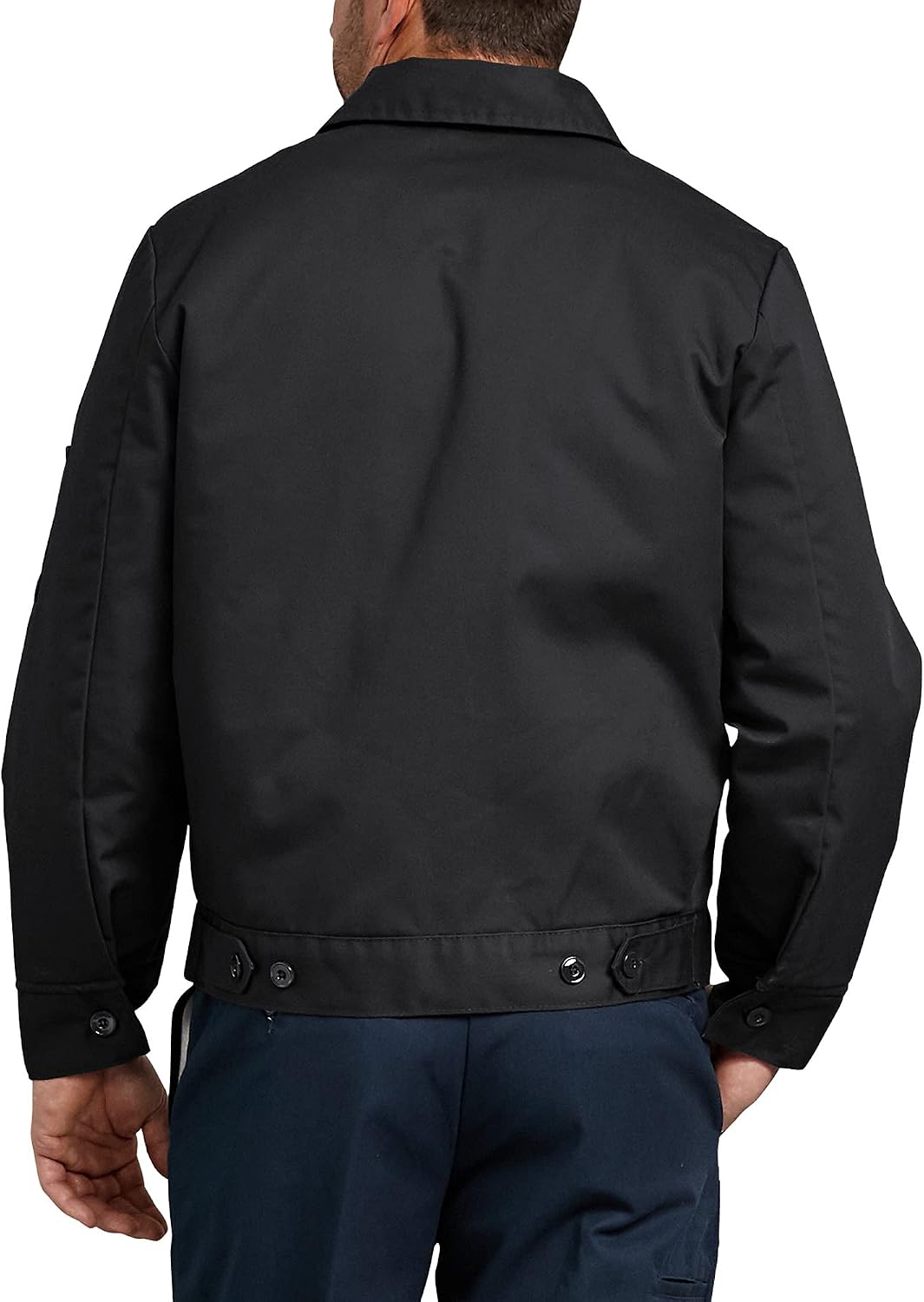
You just pulled the trigger on a Dickies Eisenhower jacket — or you’re about to — and somewhere in the back of your mind you’re wondering whether you also need that duck canvas shirt jacket you keep seeing on job sites and workwear forums. Maybe you already own one and you’re not sure how to use them together without looking like you grabbed whatever was closest to the door. This article is for both situations. We’ll break down exactly what each garment is built to do, where the two pieces overlap, where they don’t, and how to stack them into a layering system (a deliberately organized set of garments worn one over another to manage warmth, wind, and moisture) that holds up across seasons and work environments — without requiring a $400 Filson on top of it all.
If you’re new to the term “duck canvas” — it’s a tightly woven cotton fabric, heavier than standard twill, traditionally used for tents, sails, and work clothing because it resists abrasion and light wind without needing any special treatment. It softens significantly with use and washing, which is why owners talk about “breaking in” a duck canvas jacket the same way you’d break in a stiff leather boot.
What the Dickies Eisenhower Actually Is (and What It Isn’t)
The Eisenhower jacket — named after the cropped military field jacket popularized during World War II — has been a Dickies staple for decades. In its current form, it’s a hip-length, zip-front work jacket built from Dickies’ standard 8.5-ounce polyester-cotton twill blend (65% polyester, 35% cotton in most colorways). Heddels’ brand history overview notes that Dickies shifted toward poly-cotton blends across much of their line during the 1970s and has maintained that construction as a cost and durability baseline.
What that blend gets you: wrinkle resistance, faster drying, and dimensional stability (meaning it keeps its shape through repeated industrial laundering). What it costs you: the breathability and natural-fiber hand-feel that pure cotton or wool delivers. Owners consistently report that the Eisenhower runs true to size in the body but sits cropped — intentionally so, since it’s designed to be worn over a shirt tucked into work pants without bunching at the waistband.
The jacket features two chest pockets, side seam pockets, and a bi-swing back (two diagonal pleats across the upper back that allow arm-reach without pulling the jacket up). That bi-swing detail is a functional workwear specification, not a styling flourish — it’s the difference between a jacket you can swing a hammer in and one that rides up to your shoulder blades every time you raise your arm.
What it does well: lightweight outer layer, wind-block, uniform-grade durability, easy care, low price-to-performance ratio.
What it doesn’t do: insulation (it has none), moisture management under sustained exertion, or the structural integrity you’d expect from a heavier canvas or waxed shell.
What the Duck Canvas Shirt Jacket Brings to the Table
The duck canvas shirt jacket — sometimes called a “chore coat” or “blanket-lined duck jacket” depending on the manufacturer — occupies a different functional slot. Dickies’ own version runs 12-ounce cotton duck canvas, and the category more broadly (Carhartt’s Duck Detroit Jacket, for reference, sits at a similar weight) is designed to be a semi-structured mid-layer or light outer shell for cool-but-not-cold conditions.
Field Mag’s overview of duck canvas construction notes that the magic of the fabric is in its break-in arc: raw duck is stiff enough to resist abrasion and deflect wind on its own, but after 15–20 washes it develops a suppleness and drape that poly-cotton blends never achieve. That’s the buy-it-for-life argument in textile form — the garment actively improves with use.
The shirt jacket format typically means: button front (rather than zip), a slightly looser cut through the torso, shirt-style collar, and chest pockets sized to hold a folded work ticket or phone. It layers over a heavyweight flannel or hooded sweatshirt easily. Some versions ship with a blanket lining (a woven cotton plaid sewn into the body and sleeves) that adds approximately 10–15°F of usable warmth without the bulk of a synthetic-fill outer.
What it does well: mid-layer warmth, wind resistance, abrasion resistance at contact points (elbows, forearms), natural-fiber breathability, long aging curve.
What it doesn’t do: hold up to sustained rain without a wax or oil finish treatment, pack down small, or look clean enough for a client meeting.
The Layering System: How the Two Pieces Work Together
Here’s where the practitioner decision lives. A layering system isn’t about wearing the most clothing — it’s about modularity: each piece doing a specific job, so you can add or subtract without losing coverage or overheating.
The stack, from skin outward:
- Moisture-wicking base (heavyweight cotton or merino T-shirt, or a mid-weight thermal)
- Insulating mid-layer (heavyweight flannel, quarter-zip fleece, or hooded sweatshirt)
- Duck canvas shirt jacket — worn as either a structured mid-layer over the flannel, or as a light outer shell when conditions are mild and dry
- Dickies Eisenhower — worn as the outermost wind-block and weather layer when temperatures drop or wind picks up
This configuration gives you four distinct temperature bands by opening or removing layers from the outside in. The Eisenhower’s poly-cotton shell sheds light wind and drizzle better than raw duck canvas does; the duck canvas provides more insulative mass and abrasion resistance at working surfaces. They’re not redundant — they’re complementary.
Primer Magazine’s layering system overview for workwear notes a common mistake: buying two garments with identical functional profiles and expecting them to work as a system. A second Eisenhower over the first doesn’t add anything useful. The duck canvas shirt jacket under the Eisenhower does, because you’re stacking different fabric weights and structures.
By the Numbers
| Garment | Fabric Weight | Primary Function | Street Price (2026) |
|---|---|---|---|
| Dickies Eisenhower Jacket | 8.5 oz poly-cotton twill | Wind-block outer shell | $35–$50 |
| Dickies Duck Canvas Shirt Jacket | 12 oz cotton duck | Mid-layer / light outer | $60–$85 |
| Dickies Duck Canvas (blanket-lined) | 12 oz duck + cotton lining | Insulated mid-layer | $75–$100 |
The price gap between these two pieces and a single Carhartt Blanket-Lined Active Jacket ($140) or a Filson Mackinaw Cruiser ($425) is real and significant. The tradeoff: the Dickies stack is more modular and more launderable, but the single-piece premium options deliver more consistent warmth at a given temperature range and carry a longer warranty and resole-equivalent (repair/re-lining) ecosystem. Working Person’s Store’s product notes on the Dickies duck line consistently flag the garments as commercial-laundry safe, which matters if you’re outfitting a crew that sends gear through industrial washing.
Where Buyers Go Wrong (and How to Avoid It)
Sizing the Eisenhower for layering. The Eisenhower’s cropped, tailored fit is designed to be worn over a shirt — not over a duck canvas shirt jacket. If you intend to use it as the outer shell in a stack, size up one from your normal Dickies size. Workingpersonstore.com’s fit notes on the Eisenhower consistently call out that the shoulders run true but the chest and waist run slim for a work jacket. Owners across aggregated reviews report that going one size up accommodates a mid-layer without restricting arm movement.
Expecting the duck canvas to be waterproof. It isn’t, out of the box. Raw cotton duck resists light moisture through its weave density, but sustained rain will saturate it. If your work environment includes precipitation, the Eisenhower’s synthetic-content shell actually outperforms the duck canvas as a rain layer in the short term. For long-term weather resistance on the duck canvas, a pass with a wax bar or a fabric reproofer (Otter Wax is the most frequently cited option in owner forums, though any beeswax-based bar works) changes the performance profile significantly.
Treating the shirt jacket as a purely cool-weather piece. The duck canvas shirt jacket worn open over a T-shirt in 65°F shoulder-season weather is one of the most functional and low-maintenance work outfits available. It’s not just a cold-weather layer — it’s a year-round abrasion and snag shield for light work. Owners who limit it to fall and winter are underutilizing the purchase.
The Decision Rule
If you’re building from zero and your budget is $100 or under:
- Start with the duck canvas shirt jacket (blanket-lined if your climate runs cold). It does more jobs across more temperature ranges than the Eisenhower alone.
If you already own the duck canvas shirt jacket and want to extend the system’s cold-weather range:
- Add the Eisenhower as your outer wind-block. Size up one. Now you have a two-piece layering system covering roughly 30°F–65°F of usable range depending on your base layer.
If you’re outfitting a crew and need uniform-grade consistency and launderability above all else:
- The Eisenhower is the correct answer — low cost, standardizable sizing, commercial laundry safe, and durable enough for 2–3 seasons of daily site use before replacement.
If you’re buying one garment for the long haul — one piece you intend to own for five to ten years and repair rather than replace:
- The duck canvas shirt jacket wins, because it ages into itself in a way the poly-cotton Eisenhower never will. The fabric improves; the Eisenhower just wears.
These two jackets represent Dickies at its most honest: no heritage-brand mythology, no $400 price tag, just functional construction at a price point that makes outfitting yourself or a crew a straightforward math problem. The system they form together is more useful than either piece alone — which is exactly what a good layering strategy is supposed to deliver.