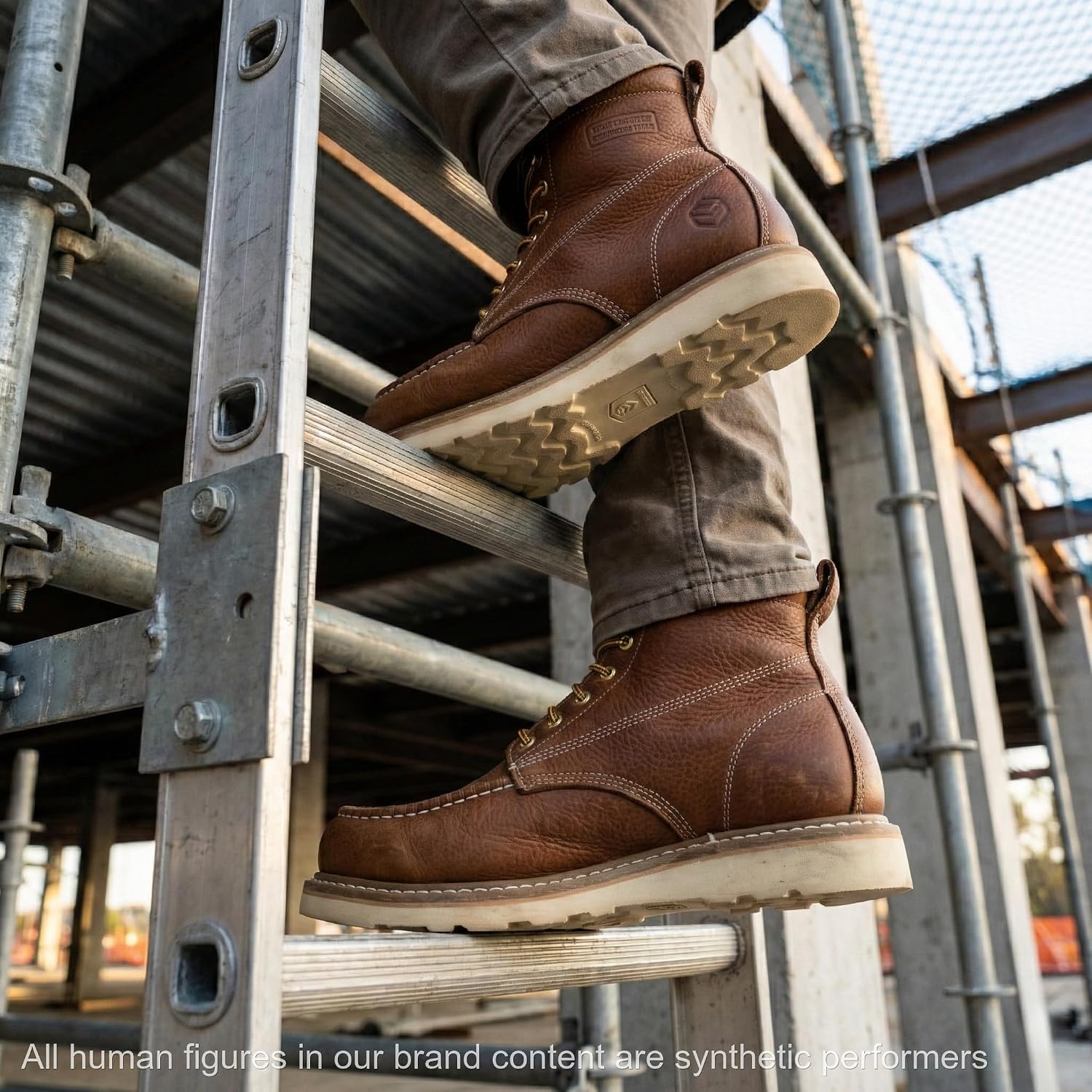
You just found a pair of boots at a major retailer marked down to $79, and the tag says “Goodyear welt construction.” You’ve done enough reading to know that a Goodyear welt is a good thing — it’s the stitching method that lets a cobbler strip off a worn sole and stitch on a new one, potentially giving a boot a decades-long life. The trouble is that the phrase “Goodyear welt” has become a marketing term that doesn’t always mean what you think it means. Some boots labeled that way are genuinely resole-ready. Others use a version of the construction that’s faster and cheaper to manufacture but essentially impossible to repair when the sole wears out. This guide will show you how to tell the difference, which sub-$100 boots actually hold up to real-world use and cobbler visits, and how to think about the math when you’re deciding whether to spend $90 or $300.
By the time you finish reading, you’ll have a clear checklist for evaluating any boot’s construction claims, a short list of budget options that owners and reviewers consistently recommend for durability, and a decision framework for when it makes sense to buy cheap versus when to stretch your budget from day one.
What “Goodyear Welt” Actually Means — and Where the Cheap Version Cuts Corners
A Goodyear welt, as Heddels’ Complete Guide to Boot Construction Methods explains, is a strip of leather or synthetic material that runs around the perimeter of the boot’s upper. It’s sewn to both the upper and an insole rib in one pass, then the outsole is stitched to that welt in a second pass. This two-seam system is what makes resoling possible: a cobbler can cut the outsole stitching, peel off the old sole, and stitch on a new one without touching the upper at all. A quality Goodyear welt also typically includes a cork or felt fill between the insole and outsole that compresses to your foot over time — part of why these boots “break in” and why longtime owners talk about them like they’re custom-fitted.
The cheaper cousin is the stitchdown or Blake stitch, which uses a single seam directly through the insole and outsole. Blake-stitched boots can be resoled, but only by cobblers with the specialized Blake stitching machine, which is far less common. Fewer still is the cement welt — sometimes marketed as “welt-style construction” — where the outsole is simply glued on with a decorative stitch that doesn’t pass through anything structural. That boot cannot be resoled in any meaningful sense. When the sole goes, so does the boot.
The problem: manufacturers sometimes print “Goodyear welt” on cement-attached boots with a cosmetic welt strip sewn along the edge for appearance only. Per the Working Person’s Store’s Work Boot Buying Guide, a genuine Goodyear welt will have visible stitching on the top of the welt (between welt and outsole) and a separate row stitching the welt to the upper. If you only see one row of stitching — or if pressing on the welt reveals it’s just a glued rubber lip — that’s your signal.
Quick inspection checklist before you buy:
- Flip the boot. Can you see two distinct rows of stitching, or does the welt appear to be one piece glued flush to the midsole?
- Is there a visible welt strip you can get a fingernail under, separate from both upper and outsole?
- Does the brand publish a resoling policy, or do authorized cobblers list the boot by name?
The Sub-$100 Landscape: What You Actually Get
At this price point, you’re not buying full-grain leather from a tannery with a name anyone in the trade recognizes. You’re buying corrected-grain or “genuine leather” upper material — which is real leather, but sanded and coated to hide imperfections, meaning it’s thinner and less breathable than full-grain. That’s not a dealbreaker for a work boot; it does affect longevity and the boot’s ability to take a conditioning oil and develop patina. What matters more at this tier is whether the welt construction is genuine and whether the boot fits a standard cobbler’s last well enough to be resoled.
By the Numbers
| Boot | Street Price (2026) | Welt Type | Resole-Ready? | Upper Material |
|---|---|---|---|---|
| Thorogood American Heritage 6” | $185–$210 | True Goodyear | Yes | Full-grain |
| Irish Setter Wingshooter | $135–$160 | True Goodyear | Yes | Full-grain |
| AdTec Men’s 9” Steel Toe | $75–$95 | Goodyear (verify) | Conditionally | Corrected-grain |
| Brahma Ridge Runner | $55–$80 | Cement welt | No | Synthetic/split |
| Georgia Boot Loggers | $85–$110 | True Goodyear | Yes | Full-grain toe cap |
Prices reflect major retail averages as of May 2026. Always inspect stitching in person or request product construction specs before buying.
Wirecutter’s Best Work Boots review draws a consistent conclusion across its update cycles: below $100, you’re unlikely to find a boot with a truly resole-ready Goodyear welt and a full-grain leather upper. The boots that land in the $85–$120 range — the Georgia Boot Logger line is the clearest example — occupy a real middle ground: genuine welt construction on a corrected-grain or split-toe-cap upper. These boots can be resoled once, sometimes twice, before the upper begins to delaminate at the stitching. That’s still a meaningful improvement over a cement-soled boot that gets one life.
What budget-tier boots with genuine welt construction can give you:
- A first resole at 12–18 months of 5-day-a-week use (based on reported wear patterns aggregated across owner forums)
- Better underfoot protection from punctures and compression — the cork fill matters for long shifts on concrete
- A boot that responds to conditioning and resoling rather than simply failing
What they won’t give you:
- The structural longevity of a boot where the upper itself is rated for 10+ years
- A boot where cobbler investment compounds linearly with number of soles replaced
The Resole Math: When Budget Boots Make Sense and When They Don’t
This is where the decision gets practical. Run the numbers on two hypothetical five-year stretches:
Path A — Budget Goodyear Welt Boot at $90
- Boot purchase: $90
- Resole at year 1.5 (assuming genuine welt): $75–$100
- Boot likely reaches structural limit (upper separation) by year 3–4 in heavy use
- Total cost over 4 years: ~$175–$200
- Cost per year: ~$44–$50
Path B — Mid-tier Heritage Boot at $185 (e.g., Thorogood American Heritage)
- Boot purchase: $185
- Resole at year 2–3: $75–$100
- Second resole at year 4–5: $75–$100
- Boot still viable at year 6+ with proper care
- Total cost over 6 years: ~$335–$385
- Cost per year: ~$55–$64
The gap is narrower than it looks, and Path B pulls ahead decisively if you get that third resole (common with Thorogood’s Vibram-soled options, per Popular Mechanics’ Best Work Boots coverage). But here’s the honest counterpoint: if you’re in a trade where boots get destroyed by chemicals, concrete abrasion, or industrial debris — not just normal wear — the upper is often what fails first, not the sole. In that environment, the budget boot’s shorter lifespan may be economically appropriate. You’re not leaving value on the table if the boot was never going to survive to a third resole anyway.
Primer Magazine’s guide to investing in quality boots makes the broader case clearly: the resole argument only holds if the boot’s upper, welt stitching, and insole board survive long enough to make the cobbler visit worthwhile. A boot with a genuine welt and a failing split-leather upper at year two is a false economy if you’re in a heavy-use environment. In a light-to-moderate use environment — landscaping, light construction, warehouse work on smooth floors — that same boot may get you two good soles and represent genuine value.
Decision Framework: If X, Then Y
Here’s the decision tree, stated plainly:
If you’re outfitting a crew of five or more and replacing boots annually anyway → Buy in the $75–$110 range, verify welt construction with the checklist above, and treat these as consumables. Don’t invest in resoling; do invest in fit to reduce injury.
If you’re a solo tradesperson with moderate daily wear and you’re building boot literacy for the first time → The $85–$120 tier (Georgia Boot Logger, AdTec Goodyear-welted options) is a reasonable entry. Get one resole. When the upper shows stress, trade up to a Thorogood or Danner rather than buying another budget boot. You’ll have learned what you actually need in fit and support.
If you’re on your feet 8+ hours daily on hard surfaces → Skip the sub-$100 tier entirely. The cork fill compression, the insole board rigidity, and the upper durability in a true mid-tier boot like the Thorogood American Heritage (around $185–$210 at major retailers) will materially affect your joints over a 10-year horizon. The cost-per-wear math favors the higher upfront spend clearly.
If you’re in chemical, oil, or extreme abrasion environments → Boot construction matters less than sole compound and upper material resistance. Confirm the sole is rated for your specific hazard (Vibram’s chemical-resistant compounds, for example, are spec-rated by compound type — check the manufacturer’s published spec sheet, not just the marketing description). A Goodyear welt on a boot with a wrong sole compound is a worse buy than a cement-soled boot with the right chemical rating.
If you find a sub-$100 boot labeled “Goodyear welt” at a mass retailer → Apply the visual checklist before you buy. If you can’t inspect in person, look up the model name alongside the words “resole” or “cobbler” in owner forums. The answer is usually in the first five posts. If owners are asking whether it can be resoled, it probably can’t.
The Bottom Line
The Goodyear welt is a genuine engineering advantage — one that lets a $185 boot outlast three $90 boots over a decade. But “Goodyear welt” on a hang tag is not a guarantee of that advantage. The construction has to be executed honestly: two rows of structural stitching, a welt strip you can physically separate from the upper, and an outsole a cobbler can replace without destroying the boot.
Below $100, genuine resole-ready Goodyear welt construction exists — but it’s uncommon, and it almost always comes paired with a corrected-grain or composite upper that limits the number of useful resoles. The math works if your use case is moderate and you’re willing to graduate up the price ladder as your footwear literacy grows. It doesn’t work if you’re expecting budget-tier materials to behave like full-grain leather over a decade of hard daily use.
Buy the boot that matches your actual environment, verify the construction claim yourself, and treat the first resole as a test — not an assumption.