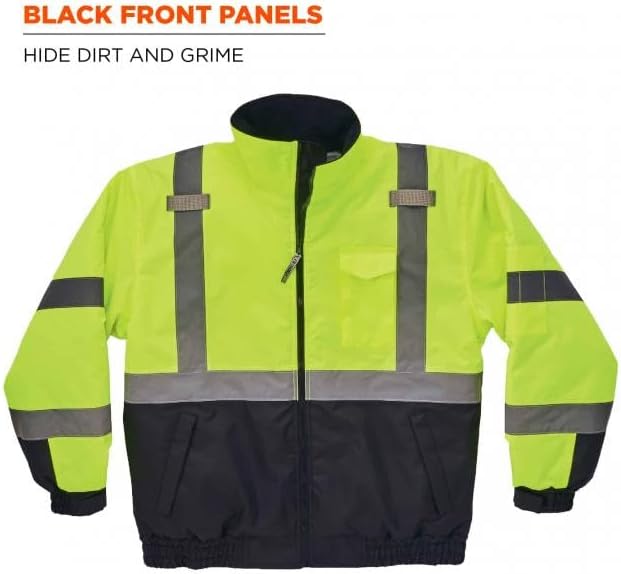
You just ordered a hi-vis rain jacket online, and when it arrived you noticed the tag says “Class 2” — but your site supervisor told you the job requires “Class 3.” Now you’re wondering whether they’re close enough to matter, or whether you’re about to turn around and ship it back. This is not a small distinction. High-visibility (hi-vis) apparel is safety equipment regulated by a national standard, and the difference between Class 2 and Class 3 can determine whether you’re legally compliant on a federally funded road project — or whether you’re standing in traffic at night with less reflective material than the law requires. This guide breaks down exactly what ANSI Class 3 means (ANSI stands for the American National Standards Institute, the body that sets voluntary safety standards later adopted into law), what to look for in a rain jacket that earns that rating, and how to choose between the options on the market without paying for features you don’t need.
What ANSI/ISEA 107 Actually Requires — and Why Class 3 Is the High Bar
The governing document is ANSI/ISEA 107-2020, High-Visibility Safety Apparel and Accessories, published jointly by the American National Standards Institute and the International Safety Equipment Association. It defines three performance classes based on two things: the total area of fluorescent background material on the garment, and the total area of retroreflective tape (the silver strips that bounce headlight beams back toward the driver).
By the numbers:
| Class | Min. Background Material | Min. Retroreflective Tape |
|---|---|---|
| 1 | 0.14 m² | 0.10 m² |
| 2 | 0.50 m² | 0.13 m² |
| 3 | 0.80 m² | 0.20 m² |
Class 3 requires the most coverage of both materials — roughly 70% more background fluorescence than Class 2, and 54% more retroreflective tape. The MUTCD (Manual on Uniform Traffic Control Devices), administered by the Federal Highway Administration, mandates Class 3 for workers exposed to traffic moving at 50 mph or higher, or any situation where a worker’s attention may be diverted away from approaching vehicles. Per OSHA Publication 3151, Personal Protective Equipment, employers on federal-aid highway projects must meet MUTCD minimums — and those minimums are almost always Class 3 for open-road work.
The practical implication: if you’re doing utility work in a parking lot at 5 mph, Class 2 may be fine. If you’re pulling fiber along a state highway, flagging on a two-lane road at night, or working as a utility lineman near live traffic, Class 3 is the floor, not the ceiling.
One additional wrinkle: ANSI/ISEA 107-2020 introduced a Type designation alongside the Class rating. Type O (Off-road) covers workers with no traffic exposure. Type R (Road) covers highway and right-of-way workers. Type P (Public Safety) covers police, fire, and EMS. For most tradespeople and construction crews, you want Type R, Class 3. A garment can be labeled “Class 3” without specifying Type R — confirm both on the label or the manufacturer’s spec sheet.
Reading a Rain Jacket Label: What the Hang Tag Can’t Always Tell You
A jacket can fail the Class 3 standard in ways that aren’t obvious at a glance. Here are the failure modes worth checking before you buy.
Tape placement, not just tape area. ANSI/ISEA 107-2020 specifies that retroreflective tape must encircle the torso (360-degree visibility) and appear on the sleeves. A jacket with the minimum tape area bunched only across the chest technically fails the standard. Look for circumferential banding — horizontal stripes that wrap all the way around the body — plus sleeve striping. Gear Junkie’s updated 2025 roundup of hi-vis jackets consistently flags tape placement as the differentiator between jackets that are compliant on paper and those that are compliant in practice.
The hood problem. When you raise a hood, it can cover the retroreflective tape on your shoulders and upper torso, dropping your effective visibility profile below Class 3 thresholds. Some manufacturers address this with tape sewn onto the hood itself. Others simply certify the jacket hood-down. If you’re working in rain and need the hood up, confirm whether the garment’s compliance rating applies with the hood deployed.
Washing degradation. Retroreflective tape loses retroreflectivity over wash cycles. ANSI/ISEA 107-2020 requires manufacturers to certify tape performance after a specified number of industrial wash cycles (typically 25 for Class 3 garments). Check whether the hang tag or the product spec sheet states compliance post-wash. If a jacket’s retroreflective tape is certified only in new condition, it may fall below Class 3 standards after a single season of regular laundering.
Fluorescent color options. The standard allows fluorescent yellow-green, fluorescent orange-red, or fluorescent red as the background color. Yellow-green has the highest daytime visibility in most lighting conditions; orange-red has higher contrast at dawn and dusk. Popular Mechanics’ 2024 piece on high-visibility work gear notes that OSHA does not mandate one color over another for most industries, but some state DOTs specify fluorescent orange for road crews — check your jurisdiction’s requirements before defaulting to whatever’s in stock.
The Rain Jacket Variables That Aren’t on the Compliance Label
Compliance gets you legal. Construction quality determines whether the jacket survives long enough to matter.
Shell fabric and waterproofing. Most Class 3 rain jackets use a polyester or nylon shell laminated with a polyurethane (PU) or ePTFE (expanded polytetrafluoroethylene — the material in Gore-Tex) waterproof-breathable membrane. PU laminates are cheaper and work well in moderate rain but can stiffen in cold and lose waterproofing faster under abrasion. ePTFE membranes breathe significantly better and hold up longer — which matters if you’re wearing the jacket for a 10-hour shift and sweating under it. Owners in long-run trade forum reviews consistently note that PU-laminated hi-vis jackets become clammy and uncomfortable after a few hours of active work, while ePTFE-laminated versions stay wearable through a full shift.
Seam taping. A waterproof shell with untaped seams leaks at every stitch hole. Fully taped seams (tape applied to every seam from the inside) are the correct call for sustained rain exposure. “Critical seam taping” — tape only at the shoulders and main seams — is adequate for light rain and significantly cheaper. For sustained wet-weather work, fully taped is worth the premium.
Cuff and hem sealing. Look for adjustable hook-and-loop or snap cuffs that cinch over gloves, and a hem drawcord that can seal the jacket against wind-driven rain. On a Class 3 jacket, the sleeves need reflective banding, so integrated cuff gaiters (a wrist gasket sewn inside the cuff) are often omitted to preserve tape visibility — check whether the design compensates with a tighter cuff adjustment.
Pockets and tool access. Work jackets need functional pockets. A breast pocket that sits behind reflective tape is difficult to access without fumbling. The better-designed Class 3 jackets route hand pockets to the lower front panels where tape placement is less constrained, and offer an interior chest pocket for documents or a phone.
Sizing for layers. A rain jacket worn over a Class 3 vest, a fleece midlayer, and a hard hat liner runs large. Most manufacturers offer “work fit” sizing — cut generously in the chest and shoulders to accommodate layers without binding. If you’re ordering for a crew, size up one from street sizing as a starting point, then adjust based on feedback from your team’s layering habits.
If X, Then Y: A Decision Framework for Buying
Here’s the decision tree based on the tradeoffs above.
If you’re on a federally funded road project or working adjacent to traffic at highway speeds: You need Type R, Class 3, full stop. Verify the label states both. Do not rely on a Class 2 vest worn over a Class 3 jacket — layered garments have their own compliance rules under ANSI/ISEA 107-2020, and the combination may not meet the standard.
If rain is occasional and budget is the constraint: A PU-laminated shell with critical seam taping in the $50–$90 range (brands like Tingley and Radians publish compliant options in this tier, available through safety distributors) will keep you dry in moderate rain. Expect to replace it every 1–2 seasons with regular use. The cost-per-season math favors this tier if you work in a dry climate or only need the jacket during shoulder-season weather.
If you work sustained wet-weather shifts (Pacific Northwest utility, construction in maritime climates, year-round road crews): The ePTFE-laminated options in the $150–$250 range from brands like Carhartt’s Sector series or Portwest’s hi-vis technical line represent a better long-run value. Owners in aggregated reviews consistently note the breathability difference becomes decisive above 4–5 hours of wear. Fully taped seams in this tier are standard, not an upgrade.
If you’re outfitting a crew: The volume math shifts toward mid-tier PU jackets purchased in quantity with a planned replacement cycle, rather than premium ePTFE jackets that won’t get the care they need across a rotating crew. Reserve the premium tier for owner-operators and foremen who own and maintain their own gear.
If hood compliance matters to you: Confirm explicitly with the manufacturer or distributor whether the Class 3 certification applies with the hood raised. A handful of manufacturers — Radians and Safety Girl among them, per their published spec sheets — offer hood-compliant Class 3 certification. Most do not.
One final point that the hang tag will never tell you: a Class 3 jacket that gets left in the truck because it’s too hot and stiff to wear is performing worse than a Class 2 jacket that’s actually on your body. Comfort and wearability are real compliance variables, even if ANSI doesn’t measure them. The rating matters. So does the jacket you’ll actually put on every morning.
Sources: ANSI/ISEA 107-2020, High-Visibility Safety Apparel and Accessories; OSHA Publication 3151, Personal Protective Equipment; Federal Highway Administration, Manual on Uniform Traffic Control Devices (MUTCD), Worker Visibility Requirements; Gear Junkie, “Best Hi-Vis Jackets for Construction and Road Work,” updated 2025; Popular Mechanics, “High-Visibility Work Gear: What the Labels Mean,” 2024.